Angles on 'straight lines' - tackling a key misconception.

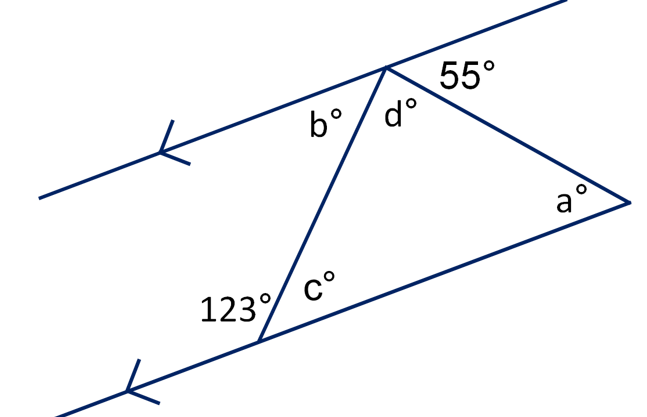
As mentioned in my blog post a couple of days ago (I know, two in a week!) I have been teaching angle properties to a couple of different year groups. One misconception I kept bumping into is surrounding pictures like this:


The key misconception I am talking about is this, "123 + c + a = 180 because those angles lie on a straight line".

For me, it is easy to sympathise with this, as of course these angles do "lie on a straight line". I think there are a couple of issues here and have been trying to deal with both through the topic. The first is a language issue, and the second involves the diagram.

The first issue is the idea of angles that 'lie on' a straight line. To me talking about angles on straight lines actually helps reinforce this misconception, rather than preventing it. Instead I think it is better to talk about angles that "form a straight line", this allows you to demonstrate that the angle 123 and c form a straight line, but that a is not needed to form the line, it is further down the line.

The other approach I have used alongside this is to get pupils to actually mark the point where the angles come together to form a straight line. Of course with the pupils being encouraged to look for angle properties rather than chase after particular angles (see my previous post), the conversation goes something along the lines of, "where do you see angles forming a straight line", followed by "can you mark where they form the straight line", which leads to pictures like these:


These sorts of pictures really help show why the two (or three in the case of the upper line) angles are the ones that form the straight line, and that a is not involved.

My advice would be that when teaching angle properties, consider how the language you use supports pupils in identifying angle pictures correctly, and ways in supporting pupils on securing the correct angles as part of the correct pictures.

Angle properties - don't go chasing angles...

Recently I have been teaching angle properties and calculations to Year 7 and Year 9. Particularly in Year 9 we have been exploring problems that require multiple properties and steps to arrive at a solution such as the problem below:

The approach I am taking here is not to focus on finding a particular angle, but rather than trying to focus pupils on the sorts of pictures they see. This means that instead of asking questions like "can you tell me the size of this angle?", I am asking questions like "Can you see any straight lines in the picture?". I am also modelling this process in examples, for example when we went through this example:
rather than trying to find h and then trying to find i, we instead just went through the different angle properties we knew and found angles that fit, including completely useless facts like 46 +90 + 44 = 180. Altogether we wrote down:
h + 46 + 90 + 44 + 61 + i = 360 (full turn)
h + 46 + 90 = 180
46 + 90 + 44 = 180
44 + 61 + i = 180
61 + i + h = 180 (all straight lines)
h = 44
i + 61 = 46 + 90 (both vertically opposite).

Only when we had written all of this down did we talk about and look at which bits of information may be useful in helping find h and i (quickly identifying multiple ways of finding both h and i) and eventually writing down the values of both angles.

This approach is definitely having an impact in terms of pupils working through these sorts of problems as they are less hung up on the fact that they can't immediately find values of an angle and are correspondingly (nice use of terminology!) more ready to make an attempt at these problems. This, coupled with a visualisation of walking down the paths that the diagram shows (more on this in a blog to come) seems to be a real support to pupils in working with these sorts of diagrams.


Dividing Fractions - not just KFC!

Is there anything with more potential for pupils to go wrong with in the arena of fractions than division by a fraction? Whether it is turning over the wrong fraction, both fractions, or not even having a clue about it, division by a fraction does seem to be a real stumbling block for a huge number of pupils. So I thought I would share the best 3 approaches I know to dividing by fractions.

1) Multiplying by the reciprocal

This is basically where KFC comes from - although it is really important that pupils do understand the language of reciprocal and can identify reciprocals for areas of maths like functions. I like to build this by looking at unit fractions first, and definitely mixing up dividing both integer and fractional values, i.e.
                                                             6 ÷ ¼

                                                             ½ ÷ ⅓


                                                            ⅚ ÷ ⅛

Showing that these are the same as 6 x 4, ½ x 3 and ⅚ x 8 respectively is an important first step. Once this is secure we would look at dividing by a non-unit fraction as dividing by something x times bigger than the unit fraction, and so needing to divide by the unit fraction and by x i.e.

                                          ⅚ ÷ ⅘ = ⅚ ÷ ⅕ ÷ 4 = ⅚ x 5 x ¼ = ⅚ x 5/4 = 25/24

Highlighting and reinforcing the fact that 4 is the reciprocal of ¼, 3 is the reciprocal of ⅓, etc makes this approach complete.

2) Dividing term by term

Although not an approach used a lot, this can be a really nice link to multiplication provided pupils can work with the fractions within a fraction that result. The idea centres on being able to divide numerators and denominators independently i.e. 

                                                                          ⅚ ÷ ⅘ =


We can then proceed to multiply by 4/4 and by 5/5 (or alternatively simply by 20/20 if pupils will understand the reason for this in one step)


3) Using common denominators

Like addition and subtraction (and particularly if you have already worked out common denominators for addition or subtraction) if fractions are given with a common denominator then dividing them can be quite straightforward.

⅚ ÷ ⅘ = 


The idea here is if you have 25 lots of something and you divide by 24 of the same something then you have 25/24 independently of the something. So


i.e. if we have 25 thirtieths divided by 24 thirtieths you have 25/24 independent of the original thirtieths.

It may be that pupils will take to one method of dividing fractions over others, and that the pupils who grasp the concept quickly can work with all three, showing they are equivalent, choosing the optimum approach for different situations and in general working with all three to achieve true mastery of division by a fraction.

Parallel lines are the same length and other such nonsense!

Recently we have been talking about the messages and misconceptions we convey without meaning to. A colleague of mine (not in my school) put me onto one - when we draw parallel lines we nearly always draw them the same length. A quick google image search suggests that this is not just the maths teachers I know:


We can see that whilst most of the pictures do show horizontal or vertical lines, all of the pictures show parallel lines the same length. Whilst some might say that this isn't really significant, I wonder if it is not something we should be aware of anyway in terms of forcing ourselves to think about the implicit messages that we give to pupils alongside the explicit content or skills we are trying to teach.

Another example that we have come across recently is that the equation 3x = 4 has no solutions because "three doesn't go into four". There was some debate as to whether this shows a general lack of understanding of division, or is a function of the fact that most equations we being to show pupils in there initial introduction to equation solving have whole number solutions. On the subject have you ever noticed that pupils struggle a lot more with equations of the form  compared to 4x - 3 = 5? Could it be that on balance they see many more equations of the second type than the first?

Some other areas of discussion:
  • Index laws using a base that is not a single term and powers that are not integers or simple fractions.
  • Area of triangles where perpendiculars are horizontal and vertical.
  • Fractions - only ever talking about simplification of fractions with a numerator and denominator that are positive integers.
There are lots of other patterns you can find in textbooks and other materials that teachers naturally draw on for their own examples - so my suggestion is to really think about the breadth of examples that are possible with the maths pupils are learning; and not just the typical examples you may have seen before.

Probability without numbers

"There are n sweets in a bag. 6 of the sweets are orange. The rest of the sweets are yellow. Hannah takes at random a sweet from the bag. She eats the sweet. Hannah then takes at random another sweet from the bag. She eats the sweet. The probability that Hannah eats two orange sweets is ⅓.

(a) Show that n2n – 90 = 0

(b) Solve n2 – n – 90 = 0 to find the value of n."

Look familiar? This question caused massive controversy when it was released in summer 2015 as it was seen as too much like things to come - many felt that it was more like the sort of question we might expect in 2017 when the new '1-9' GCSE is first examined and had no place in the current GCSE. Whether you believe this or not, the point is clear that pupils need to understand the ideas of probability and apply them outside the realms of numerical chance. With that in mind I thought I would share some ideas about developing probability without giving (too many) values.

Probability and Proportion

I am surprised we do not see more links between probability and proportion as ultimately probability is a proportional idea, the chance of something happening is measured as a proportion of the things that are possible or as a proportion of a number of trials in an experiment. In the past proportionality has generally be pretty limited to calculating an expected number of trials that would satisfy the given condition. I think it is clear though that with anything up to 25% of the new GCSE paper content being linked to ratio and proportion I think that we will see a lot more questions linking these two topics in the future. Questions like the ones below could become much more common:

1) A packet of sweets has orange, blackcurrant, strawberry and lemon sweets in the ratio 4:3:2:1. James and Sarah both buy packets of the same number of sweets. James doesn't like strawberry and so gives all of his strawberry sweets to Sarah. Sarah gives James all of her lemon sweets in return. If James takes a sweet at random from his bag, work out the probability that James take a lemon sweet.

2) A childs' shape sorter has red, green, blue and yellow shapes. The number of red shapes is twice the number of green shapes. The number of blue shapes is twice the number of yellow shapes. In total the number of red and green shapes is twice the number total number of blue and yellow shapes. Work out the probability of a child selecting a red shape if the shape is taken at random.

To be fair it strikes me that a lot of ratio and proportion question can be adapted to give a probability question - question (1) above could just as easily be "write down the ratio" rather than "work out the probability" and there are lots of ratio and proportion questions out there that could be adapted to this vein.

Probability and Algebra

Hannah and her sweets have given us a pretty clear indication that this will be a rich source of links for examiners to mine and again it makes perfect sense: if you understand the ideas of probability and algebraic expressions/equations then there should be no reason why you cant apply the two ideas together. We have also seen in the SAMs at least one question that has purely algebraic expressions inside a Venn diagram linked to probability for pupils to work with and I am sure we will see more examples in the coming years.
1)

2) A bag of counters contains red, blue and green counters. There is one more red counter than green, and one more green counter than blue. Stefan takes a counter out of the bag and puts it on the table, followed by a second. The probability that Stefan takes a blue followed by a red is 1/9. Calculate the probability that Stefan takes two greens.

It strikes me that replacing lots of the numbers in current probability questions with letters will generate questions of this type, and so would be well worth some time in faculty meetings designing.

No doubt at this point people will be thinking "yes but probability and statistics will only be 15% or so of the content..." and of course they are right, but don't forget that 15% of 240 marks is a good 36 marks, so there is plenty of space for one of two questions of this type to creep in, particularly as they can also count towards the 20%  to 30% Algebra content or 25% to 20% Ratio content so I would suggest it is well worth building questions like this into your GCSE schemes.